


Previously on Human Rights Café in Graz. Migration and Populism under the lens.
- Human Rights Cafe
- Mar 21
- 4 min read
Updated: Mar 22
At a time when democratic societies are facing increasingly complex challenges, having spaces where people can talk openly and exchange ideas feels more important than ever.
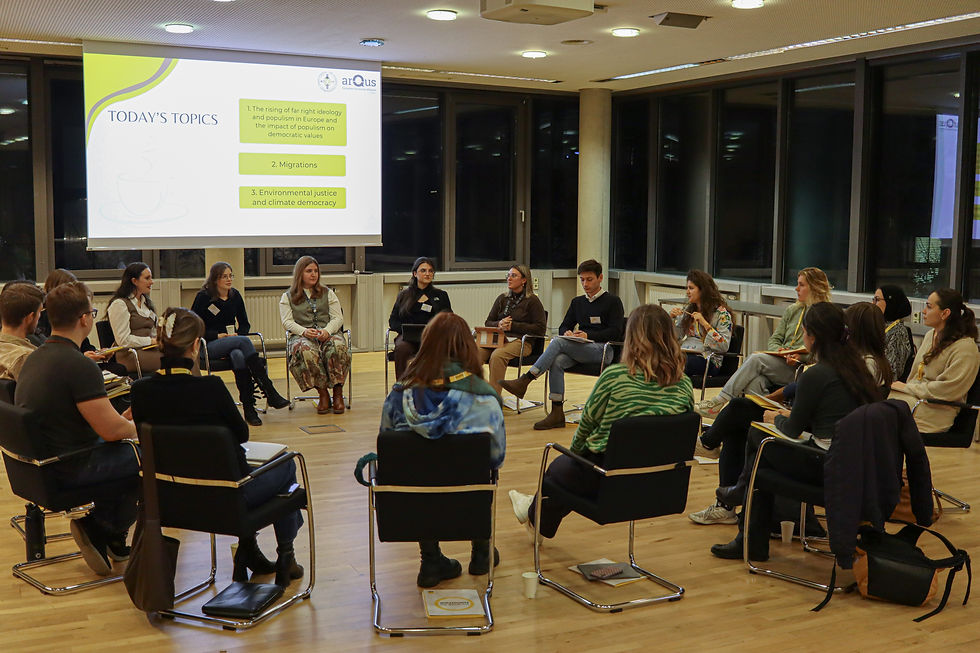
The latest edition of the Human Rights Café in Graz brought together students and participants from different backgrounds to reflect on three big topics that are shaping today’s political debate: migration and populism. Rather than approaching these issues in abstract terms, the discussion focused on how political narratives around migration and populism are constructed, and how they influence both public perception and policy.
One of the starting points of the conversation was the rise of far-right ideology across Europe. Participants were invited to reflect on what comes to mind when thinking about right-wing political movements, and certain patterns quickly emerged. Words like dehumanisation and propaganda were repeatedly mentioned, pointing to the ways in which political language can shape how groups are perceived.
Dehumanisation, in particular, was discussed as a recurring feature of far-right discourse. Participants noted that certain groups, especially migrants, religious minorities, and other marginalized communities, are often portrayed as threats to national identity or public security.
This kind of framing does not just influence public opinion: it can also make exclusionary policies appear more acceptable.
Closely linked to this was the role of propaganda. Students highlighted how simplified narratives, emotionally charged messages, and misinformation can contribute to the spread of far-right ideas. These dynamics are not limited to fringe spaces but are increasingly visible in mainstream political debates.
The discussion also touched on specific political examples, including the rise of Italy’s Prime Minister Giorgia Meloni. Her leadership was mentioned as part of a broader shift toward right-wing politics in Europe. At the same time, participants pointed out a more nuanced reality: support for far-right parties does not always come from full ideological alignment. In some cases, voters are drawn to specific policy positions—particularly on migration—rather than to the entire political agenda.
Another issue that emerged was the fragmentation of progressive political forces. Some participants suggested that internal divisions within left-wing movements can make it more difficult to present coherent alternatives, indirectly creating space for populist actors to gain influence.
In this sense, the rise of far-right politics was not seen as an isolated phenomenon, but as something shaped by wider political dynamics.
The conversation then moved more directly to migration, which remains at the center of many political debates. Participants reflected on how migration is often framed as a problem or a threat, particularly within right-wing narratives. However, as some students pointed out, migration itself is not a new or exceptional phenomenon. It has always been part of human history, driven by a wide range of factors.
An important part of the discussion focused on the distinction between migrants and refugees. While these terms are often used interchangeably in public discourse, they refer to different legal and social realities.
Refugees are individuals who are forced to leave their countries due to a well-founded fear of persecution, a definition established under international law. Migrants, on the other hand, may move for many different reasons, including work, education, or family.
Participants referred to the Geneva Convention as the key legal framework defining refugee status and outlining the protections that should be guaranteed. At the same time, some students questioned whether this framework fully reflects contemporary migration patterns. Many people on the move today do not fit neatly into existing legal categories, which raises questions about how protection systems could evolve.
The way migration is represented in public discourse was another central point. Participants noted that narratives based on fear or cultural threat can reinforce stereotypes and obscure the complexity of migration processes. These representations often influence how policies are designed and how different groups are treated.
This became particularly clear when discussing the unequal reception of different groups of displaced people. Participants highlighted the contrast between the treatment of Ukrainian refugees and that of other groups, such as Palestinian migrants. This difference was seen as an example of how geopolitical considerations, as well as racial and cultural factors, can shape both public attitudes and institutional responses.
The discussion also addressed the practical challenges migrants face when navigating asylum systems. Bureaucratic procedures are often complex, slow, and difficult to access, which can leave people in situations of prolonged uncertainty.
This raised broader questions about how migration governance can better align with human rights principles and ensure fair and efficient processes.
In the end, what emerged from the discussion was not a single answer, but a shared awareness of how interconnected these issues are. Political discourse, migration, and democratic values do not operate separately; they continuously influence one another. Engaging with these topics requires time, critical thinking, and a willingness to question the information we encounter.
Spaces like the Human Rights Café play a role in this process by offering a context where students can exchange perspectives, challenge assumptions, and develop a more nuanced understanding of the political realities shaping contemporary Europe.
Ultimately, these conversations do not end with the event itself. They continue in how participants interpret news, engage in discussions, and position themselves within broader societal debates.
Written by Shahnawaz Bhutto - MA in Human Rights and Multilevel Governance
Edited by Sofia Tamagni - MA in Human Rights and Multilevel Governance


Comments